Hello guys, as we may have a science board, I thought that it would be cool for you (and for me) to share you what I'm learning in my studies. Since the board hasn't been created yet, I'm posting this here. This subject may not be very explicit (specially because it concerns cancer) but I'll try to be it in the future subjects. I just wanted to give you an example of what kind of content you'd expect if the board was created. We could discuss about vaccines and so on.
Is cancer treatable?1. IntroductionOur body is made of organs that are made of tissues, made of cells. During our development and during our life, our cells must proliferate so tissues grow but also whenever you hurt yourself, the tissue that gets hurt gets replaced. But not all of our cells are capable of proliferation. Only a specific type of cells called "stem cells" are capable of proliferation.
Each one of our cells has the exact same copy of genetic material (DNA) and so, 46 identical chromosomes: 22 pairs of autosomal chromosomes (Chr. 1 to Chr. 22) and 2 sexual chromosomes (XX for women, XY for men).
DNA is transcribed in the nucleus into mRNA (messenger RNA) by RNA polymerase II. Then, mRNA undergoes some processing, is exported to the cytoplasm and is translated by ribosomes into a chain of amino acids that will be folded into a fully functional protein.
If we stop here, anyone would basically say that all of our cells should express the same proteins. But if this would be the case, all of our cells would have the same function and would have the same "phenotype". But, despite having the same genetic material or "genotype", our cells don't have the same "phenotype". This is due to the fact that gene expression (DNA=>mRNA=>protein) is tightly regulated by different mechanisms:
1) Epigenetics (epi = above, genetics = genes): this is the first mechanism that regulates gene expression in our cells. DNA is not naked in the nucleus, it binds to some proteins called "histones" that allow the compaction of DNA into heterochromatin. The non-compacted parts are called euchromatin. Compacted chromatin represses gene expression since RNA polymerase does not have access to DNA while non-compacted chromatin allows gene expression. Each one of our cells does not compact DNA in the same way, explaining why each one of our cells expresses different genes.
2) Transcription factors (TFs): because of the reason stated above, our cells will not express the same genes and so, will not express the same transcription factors either. TFs are proteins that will bind to the promoter of genes (sequence where RNA polymerase binds to) and will either favour or repress the binding of RNA polymerase. So, based on that, a type-1 cell will express TF1 and not TF2 while a type-2 cell will express TF2 and not TF1. So, type-1 and type-2 cells will not express the same genes. But, this is a pretty simplistic view. There are also some TFs that are expressed in each one of our cells and these are called "ubiquist". We could therefore imagin that type-1 and type-2 cells express both of them TF3.
2. DNA alterationsHowever, DNA is not a perfect molecule and may undergo several alterations.
2.1 Mutations1) Silent mutations: a base in the DNA (reminder: A, C, T or G) is changed into another but the resulting CODON does not change the amino acid (reminder: a codon is made of 3 nucleotides will bind a tRNA that will bring a specific amino acid in the sequence of the protein. We have 64 codons for 20 amino acids and therefore, a lot of them will bring the same amino acids).
2) Missense mutations: an amino acid in the sequence of a protein is changed into another, this may either result in an alteration of the 3D conformation and so in the function of the protein or not.
3) Nonsense mutations: the codon of an amino acid is changed into a STOP codon and therefore, translation will stop earlier than normal, which will result in a truncated protein.
4) Frameshift mutations: since gene expression is done per 3 nucleotides (1 codon = 3 nucleotides), if there is a mutation that adds or removes a base in the DNA, this will result in a Frameshift and so, in a non-functional protein.
2.2 Chromosomal alterations1) Aneuploidy: the cell has an abnormal number of chromosomes.
2) Translocation: there is an exchange of DNA between a chromosome and the other.
3) Inversion: an inversion occurs in a part of DNA.
4) Amplification: a DNA fragment (containing a gene) may be amplified.
5) Deletion: a DNA fragment (containing a gene) may be deleted.
3. What is cancer?Because of the alterations stated above, you can understand that a cell will either overexpress/overactivate or underexpress/inactivate some genes, which will give it a proliferative advantage.
Genes that are overexpressed or overactivated in cancers are called oncogenes.
- Oncogenes will stimulate cell proliferation and cell growth, and will inhibit cell death.
- These mutations are called gain-of-function mutations. Only one mutation in 1 of the 2 chromosomes will be sufficient (heterozygous).
Genes that are underexpressed or inactivated in cancers are called tumor suppressor genes.
- Tumor suppressor genes will inhibit cell proliferation and cell growth, and will stimulate cell death.
- These mutations are called loss-of-function mutations. Since we have one copy of the gene (allele) in both chromosomes, the mutation must be homozygous (in both alleles) so cells have a proliferative advantage.
So, whether we have a heterozygous gain-of-function mutation in an oncogene or a homozygous loss-of-function mutation in a tumor suppressor gene, this will result in a proliferative advantage that will give a benign tumor. But this is not cancer yet. The benign tumor is localised and does not invade the surrounding tissues (nor the blood circulation).
However, the proliferative cells may gain other mutations and this will result in a malign tumor that will be able to invade the surrounding tissues. Cancer is by definition a malign tumor.
If the cells keep accumulating mutations, they may even go further and invade the blood circulation. Once they reach the blood circulation, they are called metastasis. Through this process, the cancer will be able to disseminate and reach other organs.
4. Cancer is a clonal and heterogenous diseaseSo, as you can understand, cancer begins from a single cell (founder cell) that acquires a DNA alteration, making cancer a clonal disease.
However, as I've already told you, some cells may acquire further mutations. Therefore, not all of the cells within a benign or malign tumor will have the same phenotype/mutations, making cancer a heterogenous disease.
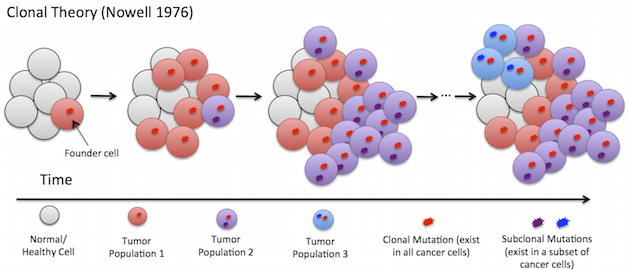
In the image above, you can see that initially, there is a founder cell that acquires a mutation (red cell). This mutation is called a clonal mutation because it will be found in all of the cells of the tumor as all of the cancerous cells will derive from this cell.
However, as cells proliferate, they may acquire new mutations called subclonal mutations (a red cell becomes purple). But not all of the cells of the initial clone acquire the mutation so as cells proliferate, you can see that there are 2 clones (a red one and a purple one), making cancer a heterogenous disease.
And this can occur several times, until the tumor has crossed all of its obstacles and reached the blood circulation.
5. Example of breast cancer5.1 ER+ breast cancer (ER+ PR- Neu-)This type of breast cancer is characterized by the presence of a mutation within the receptor of estrogens (ER). Estrogens are basically hormones that stimulate the growth of mammary glands during pregnancy. However, some women may acquire a mutation within the gene of this receptor, resulting in a benign tumor in breast and eventually to breast cancer when further mutations are acquired.

To make it simple, you can see that the evolution of this cancer is linear and we basically have only 1 main clone at the end.
Since this cancer is not very heterogenous, we can basically imagine using a treatment that would either block the receptor or do a therapy to prevent estrogen to reach the tumor. This would basically result in a shrinking of the tumor since the tumor is dependant on estrogens to grow.
5.2 Triple negative breast cancer (ER- PR- Neu-)However, there is an other type of breast cancer that is triple negative, meaning that it has no mutation in the estrogen receptor (ER), in the progesteron receptor (PR) or in the EGF receptor (so no Neu receptor). Estrogen, progesteron and EGF (epithelial growth factor) are hormons that stimulate cell growth.
Since there is none of these mutations, it is impossible to use a specific treatment for this cancer and therefore, the only option is chemotherapy.

In addition to that, you can see that the evolution of this cancer is not linear like the ER+ breast cancer but very branching and at the end, this results in 3 clones. So, even if we isolate a gene that is specific in a clone, there is another clone to take over.
6. Resistance to treatmentsSo, cancers are very known to resist either to specific treatments or even to chemotherapy but how is that possible? There are 2 possible mechanisms.

a) The treatment kills all of the cells of a specific clone but as I've told you, cancer is a heterogenous disease most of the time (specially in the case of the triple negative breast cancer), so a clone that is not targeted by the treatment may already harbour a mutation that makes the cell resistant to the treatment. In this case, they've used a treatment that targets the EGF receptor (EGFR) in a lung cancer. However, you can see that there is a minor clone that harbours a mutation in EGFR (T290M => in position 290 of the protein, threonine, an amino acid, is changed into a methionine due to a point mutation). Therefore, the treatment cannot block this mutated version of the receptor and therefore, this clone takes over and gives a recurrent tumor (recurrent = a tumor that occurs after the patient thinks that he's supposedly been treated).
b) The treatment doesn't kill all of the cells as it's efficiency is not of 100%. Therefore, some cells resist the treatment and are called "persister cells". These cells, with time, may acquire other mutations that may make them resistant to the treatment. When that happens, the cancer is no more targeted by the treatment and a more agressive recurrent tumor appears.
7. ConclusionOur cells are constantly turning on and off different mechanisms such as cell growth, cell death and so on through transcription factors (proteins) and epigenetic mechanisms. But, because of our environment or genetic predispositions, a cell may acquire a DNA alteration. Most of the time, the DNA alteration is either corrected or the cell is eliminated from the organism by cell death or by our immune system.
However, when the DNA alteration is not corrected or the immune system does not eliminate the cell, this may result in a clonal proliferation that will give a benign tumor. If nothing is done, cells may acquire further mutations that will result in a malign tumor and eventually, into a metastasis. But not all of the cells mutate at the same time nor in the same way, making cancer a heterogenous disease. The heterogeneity of cancer may either be very low like in the case of ER+ breast cancer or very important (triple negative breast cancer). Therefore, it is impossible to imagine treating all of the cancers by a universal treatment and even if we only focus at a particular cancer and develop a treatment (treatment blocking EGFR for instance), there may be resistance mechanisms that would be responsible of a (more agressive) recurrent tumor.
However, scientists are currently doing research in order to identify specific markers (proteins) that could be used either to develop new treatments that would target such markers or even strengthen our immune system to detect them.
 Topic: Is cancer treatable? (Read 160 times)